
“Don’t assume the quality of your health based on how you feel.”
Many people believe being healthy simply means feeling good or being free from pain. But what if changes were occurring in your body long before symptoms ever appeared?
One of the biggest reasons I encourage regular spinal checkups is because your body is incredibly good at adapting and compensating. Problems can develop beneath the surface for weeks, months, or even years before they become painful.
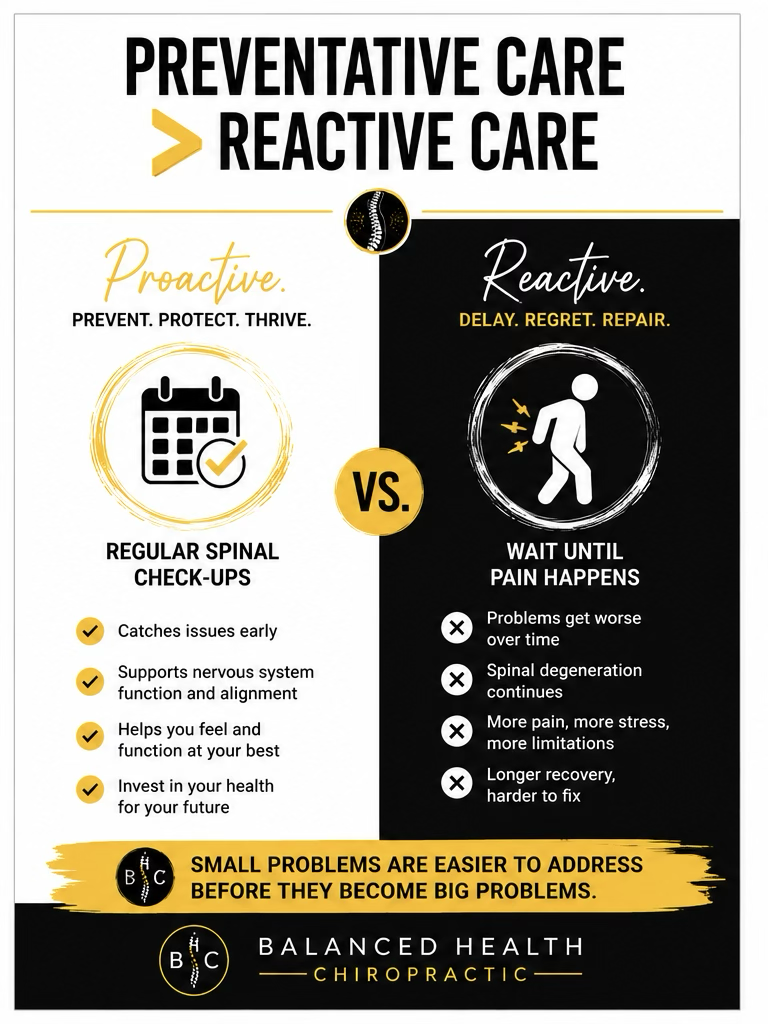
Preventative care is about maintaining your health before small problems become larger ones.
Your nervous system controls and coordinates every function in your body—from movement and balance to healing, digestion, and organ function. When your spine is healthy and moving properly, your nervous system can communicate more effectively with the rest of your body.
Think about maintaining your spine the same way you think about caring for your teeth. You don’t wait until every tooth hurts before scheduling a dental appointment. Regular checkups help identify small problems before they become major ones.
The same principle applies to your spine.
By staying proactive, you’re investing in your future health instead of simply reacting when something goes wrong.
What Happens When Problems Are Ignored?
Changes within the spine rarely happen overnight. They usually develop gradually over time.
Healthy Spine

Normal movement and healthy disc spacing allow your nervous system to function efficiently.
Phase 1: Reduced spinal movement begins placing stress on the discs and surrounding tissues.
Phase 2: Structural changes begin developing as the body adapts to long-term stress.
Phase 3: Significant degeneration and loss of healthy disc space may occur.
Our goal is to identify these stress patterns long before permanent changes develop.
Why We Don’t Rely on Symptoms Alone
One of the biggest misconceptions about health is believing that “no pain means no problem.”
Pain is actually responsible for only a small portion of what your nervous system does.
Your nervous system also controls:
✔ Muscle function
✔ Balance and coordination
✔ Healing
✔ Digestion
✔ Sleep
✔ Organ function
✔ Movement
That means dysfunction can exist long before pain ever appears.
Many people are surprised to learn that pain is often the last symptom to appear and the first symptom to disappear.
Did You Know?

Degenerative changes can begin after just four weeks of reduced spinal movement.
That’s why regular spinal checkups are so important—even when you’re feeling great.
How We Measure More Than Symptoms
At Balanced Health Chiropractic, we don’t simply ask, “Where does it hurt?”
We evaluate how well your body is functioning by using several tools that allow us to identify stress patterns before they become larger problems.
Nervous System Scans
Help us evaluate how your nervous system is functioning and adapting to stress.
Full Spine X-rays (when appropriate)
Allow us to see structural changes, spinal alignment, and areas that may need corrective care.
Postural Analysis
Shows how your body has adapted to years of stress, repetitive movements, injuries, and daily habits.
Nervoscope Readings
Measure temperature differences along the spine that may indicate irritation within the nervous system and allow us to monitor your progress over time.
Your Care Plan Is Personalized
Every person is different.
Some patients benefit from being checked every four weeks, while others may need more or less frequent care depending on:
• Work demands
• Stress levels
• Sports and exercise
• Pregnancy
• Previous injuries
• Daily posture
• Overall health goals
There isn’t a one-size-fits-all schedule because every spine responds differently.
Our goal isn’t simply helping people feel better. Our goal is helping people function better.
When your nervous system functions better, your body has a greater opportunity to:
✔ Move better ✔ Sleep better ✔ Recover more efficiently ✔ Improve posture ✔ Handle everyday stress ✔ Continue doing the things you love
Your future health is built by the choices you make today.

Snack ideas!
Chia Seed Pudding & Date Snickers
Date Snickers

Ingredients
- 9 squishy Medjool dates
- 3 tablespoons peanut butter (or other nut butter)
- 2 tablespoons chopped peanuts
- ¼ cup dark chocolate chips
- flaky sea salt (optional topping)
Instructions
- Use your fingers to split each date in half and remove the pit in the center. If you prefer, you can use a knife to carefully cut them in half. Arrange the date halves cut-side up on a plate lined with parchment paper.
- Add roughly a ½ teaspoon of peanut butter to the center of each date half. Then sprinkle the chopped peanuts on top so that each piece will have some crunch.
- Melt the chocolate chips in a double boiler (or in the microwave) until smooth. To make a double boiler, add an inch of water to a small saucepan and bring that to a boil on the stovetop. Place a heat-safe bowl snugly over the top of the pan and add the chocolate chips. Stir until the steam melts the chocolate.
- Use a spoon to drizzle the melted chocolate over each date half. Only the top of the date needs to be coated, since the bottom will already be sweet from the date. Sprinkle flaky sea salt over the top while the chocolate is still shiny.
- Place the plate in the fridge for 10 minutes or until the chocolate is firm. Then, these are ready to eat! Date snickers can be stored at room temperature for at least a week, or store them in an airtight container in the fridge for up to a month.